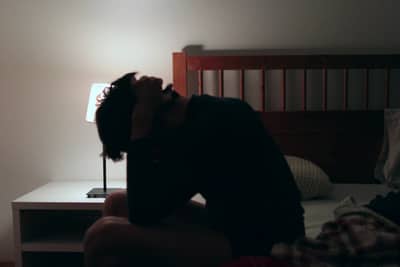
Sleep paralysis: why you wake up frozen, and why someone is in the room
People describe it the same way across centuries and continents. You surface out of sleep, awake enough to recognize your own ceiling, and nothing moves. Not an arm, not your mouth. Your chest feels compressed. And very often there is something in the room with you, standing near the bed or sitting on your chest, and you are certain of it in a way that does not survive daylight.
Then it ends, usually within a minute or two, and you lie there with your heart going, trying to work out whether to tell anyone.
I am Corinne, a licensed psychologist. Sleep paralysis comes up in my office more than people expect, usually sideways, long after the reason someone booked. They are rarely asking me whether it was real. They are asking whether it means something is wrong with them. Here is what it is, what the research shows about who gets it, and what the honest answer is about making it stop.
Your body's REM paralysis is still running after your mind has woken up
During REM sleep, the stage where most vivid dreaming happens, your brain actively paralyzes most of your voluntary muscles. This is useful. It is what stops you from standing up and acting out a dream. Breathing and eye movement are spared, which is why the eyes can often still move during an episode and why you keep breathing even when it feels as though you cannot.
Sleep paralysis is that paralysis arriving out of sequence. Consciousness returns while the muscle atonia of REM is still switched on, so you are awake inside a body that is still asleep. The sleep literature calls the condition isolated sleep paralysis when it happens outside of narcolepsy, and the International Classification of Sleep Disorders gives recurrent isolated sleep paralysis its own diagnostic entry.
Episodes run from a few seconds to a couple of minutes. They end on their own. In the moment that is almost impossible to believe, which is itself part of why people find them so frightening.
Roughly one person in thirteen has had at least one episode
Sharpless and Barber published a systematic review in Sleep Medicine Reviews in 2011 that pooled 36,533 participants and found a lifetime prevalence of 7.6 percent in the general population. That is somewhere near one person in thirteen.
The same review found much higher rates in two groups: 28.3 percent of students and 31.9 percent of psychiatric patients had experienced it, rising to 34.6 percent among patients with panic disorder. It also found higher lifetime rates among minority populations than among white participants.
Those numbers matter for one practical reason. If you have had an episode, you are not describing something rare or exotic, and the clinician you tell has almost certainly heard it before. People stay quiet about this for years because it sounds, when said out loud, like a report of being haunted.
The presence in the room is the most consistent part, and it comes in three shapes
The hallucinations that accompany sleep paralysis are not random. Work led by James Cheyne sorted them into three clusters that keep reappearing across samples.
Intruder. The sense of a presence, often accompanied by footsteps, a shadow, voices, or the feeling of being watched or touched. This is the one people mean when they talk about a figure by the bed.
Incubus. Pressure on the chest, a weight, the feeling of being suffocated or held down. This is where the old European word for a nightmare comes from, a creature that sits on the sleeper.
Vestibular-motor. Floating, flying, spinning, the sensation of leaving your body or looking at yourself from across the room.
Intruder and incubus experiences tend to arrive together and tend to be terrifying. Vestibular-motor experiences are more often reported as neutral or even pleasant. The shapes are stable enough across cultures that the folklore tracks them closely: the Old Hag in Newfoundland, kanashibari in Japan, a jinn sitting on the chest in parts of the Middle East and North Africa. Different explanations, same reported sensations.
There is a reasonable mechanism behind the terror. You are awake, immobilized, and your threat-detection system is running without the sensory input it needs to resolve what is happening. A brain in that state does what brains do: it produces an explanation, and the explanation is a person in the room.
It counts as a disorder only when it happens often and frightens you
A single episode after a bad week is not a diagnosis. Recurrent isolated sleep paralysis requires repeated episodes along with distress about them, bedtime anxiety being the common form, and it requires that the episodes not be better explained by something else, narcolepsy in particular. The current classification does not set a minimum number of episodes, which leaves clinical judgment in the picture rather than a counting rule.
What this means for you is simple. Two episodes during finals week in college is an anecdote. Dreading bedtime most nights is worth raising with someone, and the dread is usually the part that responds fastest.
Among people with PTSD the rates climb steeply
This is the association that gets the least attention outside the research and the most attention in my office.
Hinton and colleagues studied 100 Cambodian refugees attending a psychiatric clinic and published the results in Depression and Anxiety in 2005. Forty-nine of the 100 had experienced at least one episode of sleep paralysis in the previous twelve months. Among those with PTSD, 65 percent were having episodes monthly, against about 15 percent of the patients without PTSD, and PTSD severity scores tracked with how often episodes occurred.
That is one clinical sample from one population, and it should not be read as a general rate. But it points at something I see repeatedly. For a trauma survivor, sleep paralysis is not just frightening in the way it is frightening for everyone. It lands on a nervous system already organized around the expectation of threat, and in a body that has learned being unable to move means something specific. The episode then feeds the hypervigilance that made sleep bad in the first place.
When sleep paralysis shows up alongside nightmares, hypervigilance, and a history of trauma or abuse, I treat the trauma. The episodes are downstream of a sleep architecture that trauma has disrupted, and they tend to settle as the rest of it does.
Broken and irregular sleep is the most changeable cause
Sleep deprivation is the trigger that comes up most reliably, and the one most under your control. So is schedule disruption. A study of workers in high-stress professions found that anxiety disorders, PTSD, chronic stress exposure, and shift work all mark people out as more likely to experience this.
Want to talk about it? Click here
That last one is why I mention sleep paralysis to the pilots and controllers I work with. Rotating schedules, night duty, and chronic sleep debt are an occupational feature rather than a lifestyle choice, and the people living on them often read an episode as a sign they are breaking down, when the more parsimonious explanation is sitting on their roster. If you fly or work traffic, that whole picture is worth talking about with someone who understands the schedule.
The boring interventions carry most of the weight here: a consistent sleep and wake time, enough hours, cutting alcohol close to bed, and treating the anxiety that is keeping you up rather than waiting for the sleep to fix itself.
There is one small trial of a technique for use during an episode
Most of what circulates online about escaping an episode is folklore of a newer kind: wiggle a toe, move your eyes, cough. Those reports are unstudied and I have no evidence to offer for them.
The one treatment with a published trial is Meditation-Relaxation therapy, tested by Jalal and colleagues in 2020. It has four steps applied during the episode itself: reappraise what is happening as a known, harmless, time-limited event; emotionally and psychologically distance yourself from the content, including the presence; turn attention inward to a focused meditation object; and relax the muscles rather than struggling against the paralysis.
Over eight weeks, participants using it reported about half as many days with episodes and about half as many episodes overall. I want to be clear about the size of that study: six people received the therapy and four were in the comparison group, it was open label and not randomized, and the participants had narcolepsy. It is a promising pilot, and no more than that.
What makes it plausible, and the reason I teach something close to it, is that three of its four steps are standard anxiety treatment. Reappraisal, defusion from frightening content, and deliberate relaxation instead of resistance are what we would do with a panic attack. An episode of sleep paralysis has the structure of a panic attack that you cannot move during, and the fear of the next one does the same work that anticipatory anxiety does everywhere else.
Four symptoms that send you to a sleep physician first
Say this out loud to a doctor rather than to me if any of the following is true: you fall asleep involuntarily during the day, you have sudden episodes of muscle weakness triggered by laughter or strong emotion, you snore heavily or stop breathing in your sleep, or the episodes started after a new medication. Those point toward narcolepsy, sleep apnea, or a drug effect, and they call for a sleep study rather than a course of therapy.
I am a psychologist. I can treat the anxiety, the trauma, and the dread of going to bed, and those are often the whole of it. I cannot diagnose a sleep disorder from a conversation, and anyone who tells you they can is overreaching.
The bottom line
Sleep paralysis is your body's dream-time paralysis overstaying by a minute while you are awake to notice. It is common, it is documented across every culture that has written anything down, and the figure in the room is produced by the same brain producing the fear. None of that makes it less horrible while it is happening, and nobody should have to talk themselves out of dreading it alone.
The parts worth treating are the sleep you are not getting, the anxiety that is keeping you awake, and the trauma underneath both when there is one. If any of those sound like your situation, a free consultation is fifteen minutes and you can open with the thing you have not said out loud yet. If you landed here because of what your sleeping brain produces generally, I have also written about recurring dreams.
Frequently Asked Questions
What causes sleep paralysis?
During REM sleep your brain paralyzes most voluntary muscles so you do not act out dreams. Sleep paralysis happens when consciousness returns while that paralysis is still switched on, so you are awake in a body that is still in REM. Sleep deprivation, irregular or rotating schedules, stress, anxiety disorders, PTSD, and narcolepsy all make episodes more likely.
Is sleep paralysis dangerous?
The episodes themselves are not physically dangerous. Breathing continues even when your chest feels compressed, and episodes end on their own within seconds to a couple of minutes. The harm is in the fear: people start dreading sleep, which costs them sleep, which makes further episodes more likely.
Why do I see someone in the room during sleep paralysis?
Hallucinations during sleep paralysis fall into three well-documented clusters: a sensed presence with shadows, footsteps or touch; pressure on the chest and a feeling of suffocation; and floating or out-of-body sensations. You are awake, unable to move, and your threat-detection system is running without the information it needs, so your brain supplies an explanation. Across cultures that explanation takes local form, from the Old Hag to kanashibari.
Is sleep paralysis a sign of a mental illness?
Not by itself. Roughly 7.6 percent of the general population have had at least one episode. Rates are higher among people with panic disorder and considerably higher among people with PTSD, so frequent episodes are worth raising with a clinician, but a few episodes during a stressful stretch are common and mean little on their own.
How do I stop sleep paralysis?
Start with sleep itself: consistent sleep and wake times, enough hours, and less alcohol near bedtime. Treat the anxiety or trauma underneath if there is one. For use during an episode, the one published trial tested a meditation and relaxation method with four steps, reappraising the event as harmless, distancing from the content, focused inward attention, and muscle relaxation rather than struggle. That trial was small and preliminary, though its components are standard anxiety treatment.
When should I see a doctor about sleep paralysis?
See a physician rather than a therapist if you fall asleep involuntarily during the day, have sudden muscle weakness triggered by laughter or emotion, snore heavily or stop breathing during sleep, or the episodes began after starting a medication. Those suggest narcolepsy, sleep apnea, or a drug effect, and they need a sleep study.
Keep Reading
Related articles

What Does It Mean to Dream You're Trapped in a Building? A Psychologist Reads Her Own Dream